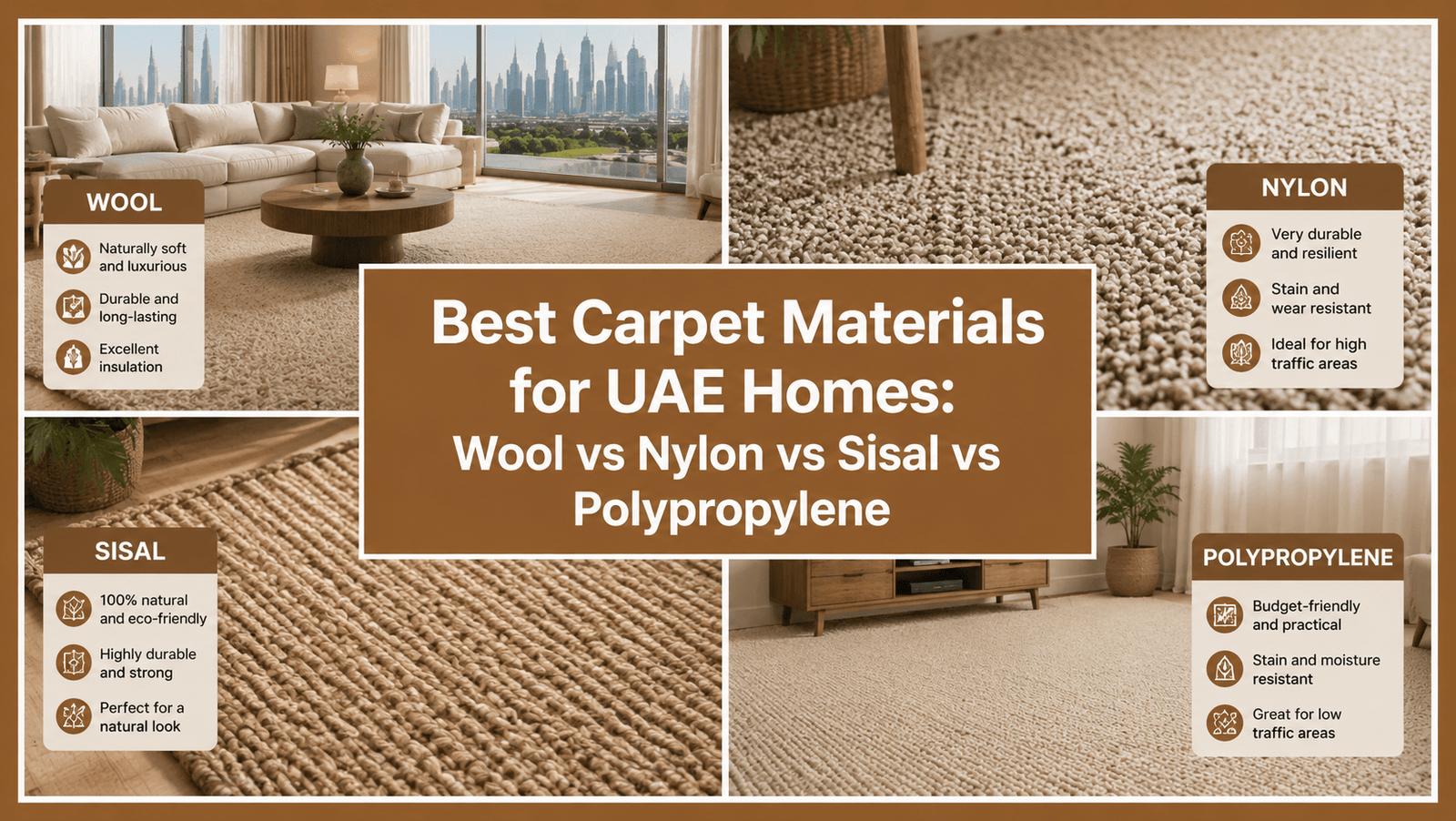
Choosing the right carpet fiber is more important than focusing only on colour, pattern, or price. The fiber determines durability, stain resistance, comfort, and how well the carpet withstands daily wear, sand, and spills in Dubai’s climate. With over 11 years of experience and 11,900 completed projects, Floor Mart has found that selecting the right fiber for each room is the key to long-lasting carpet performance.
How UAE Climate Conditions Stress Every Carpet fiber Differently
Before examining each fiber individually, it is worth establishing the specific conditions that every carpet installed in a Dubai or Abu Dhabi home must contend with. These conditions affect each fiber type differently, and understanding them is what makes a UAE-specific carpet guide genuinely useful rather than a copy of generic flooring advice written for temperate climates.
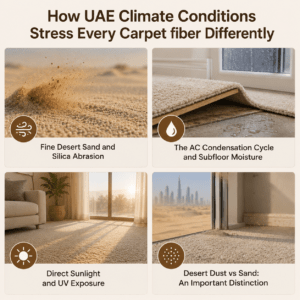
Fine Desert Sand and Silica Abrasion
The sand that enters UAE homes is finer and sharper than the beach sand found in most coastal countries. It carries silica particles that settle into carpet fibers and act as a slow-motion abrasive against the pile with every footstep. Over time, this continuous abrasion dulls the fiber surface and accelerates the matting effect that makes carpet look aged and flat before its time. Fibers with higher intrinsic resilience, meaning those that spring back to their original shape after compression, resist this matting effect significantly longer than fibers with low resilience.
The AC Condensation Cycle and Subfloor Moisture
UAE homes cycle between high outdoor humidity and cooled interior environments continuously throughout the year. This creates conditions where moisture can accumulate at the subfloor level, particularly in ground floor apartments and units above podium parking areas. Natural fibers that are hygroscopic, meaning they absorb ambient moisture, are more susceptible to the effects of this moisture cycling than synthetic fibers with closed-cell structure. In coastal properties on Palm Jumeirah, Dubai Marina, or JBR, where ambient humidity is consistently higher than inland areas, the moisture behaviour of the carpet fiber becomes a meaningful selection criterion.
Direct Sunlight and UV Exposure
Properties with south or west-facing windows in Dubai receive intense direct sunlight, and the UV component of that sunlight degrades colour in any fiber that has not been treated or constructed with UV resistance in mind. Solution-dyed synthetic fibers, where colour is part of the fiber structure rather than applied to the surface, maintain their colour significantly longer under UAE sun exposure than piece-dyed equivalents. This distinction is one that almost no carpet guide in the UAE market currently explains, and it is one of the most practically important specifications to ask about when purchasing carpet for a sunlit room.
Desert Dust vs Sand: An Important Distinction
Beyond silica sand, UAE homes also accumulate fine mineral dust from the broader desert environment that is lighter than sand and travels further through ventilation gaps and air handling systems. This dust, if not vacuumed regularly, accumulates at the base of the carpet pile near the primary backing and creates a permanent grey discolouration that no amount of surface cleaning removes. Carpet fibers with a tighter pile construction, such as loop pile and short cut pile, accumulate this deep-seated dust more slowly than long plush pile fibers because the particle has less depth to travel before reaching the backing.
Wool: The Premium Natural fiber
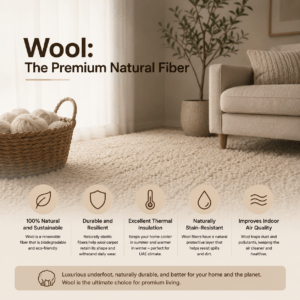
Wool has been used as a carpet fiber for thousands of years across the Middle East and Central Asia, and its continued use in the UAE premium residential market is not tradition for its own sake. Wool genuinely outperforms all other natural fibers and most synthetics in specific performance categories that matter for high-quality UAE home installations.
What Makes Wool Perform the Way It Does
Wool carpet offers excellent resilience thanks to its natural crimped fibers, allowing it to recover from foot traffic and furniture marks better than most synthetic materials. Its protective outer layer helps resist dirt and gives you more time to clean spills before they become permanent stains. Wool is also naturally flame-resistant, making it a safer and more durable choice for Dubai homes where candles and incense are commonly used.
Wool’s Weaknesses in the UAE Context
Wool is the most expensive carpet fiber, making it best suited for long-term installations rather than rental properties. It requires gentle maintenance with pH-neutral, wool-safe cleaning products to avoid damage. In humid coastal areas of the UAE, wool may absorb moisture and feel slightly damp, although this is rarely an issue in well air-conditioned homes.
Where Wool Is the Right Choice in a UAE Home
- Master bedrooms in owned properties: Where the investment horizon is long and the barefoot comfort of wool underfoot morning and evening justifies the premium.
- Formal majlis and reception rooms in villas: Where the visual quality and natural richness of wool contributes to the room’s prestige and the traffic level is lower than a family living area.
- Prayer rooms: Wool’s natural flame resistance, hypoallergenic properties, and soft underfoot quality make it appropriate for dedicated prayer spaces.
- Investment properties intended for the high-end rental market: Where the specification of the property justifies wool as part of the overall fit-out quality.
Nylon: The High-Performance Synthetic
Nylon is the most widely installed carpet fiber in UAE homes and for good reason. It occupies the position of strongest all-round performer across the widest range of UAE residential conditions, combining durability, resilience, and stain resistance at a carpets price point that positions it as the sensible default choice for most rooms in most properties.
Solution-Dyed vs Piece-Dyed Nylon: The Distinction That Matters in Dubai
When buying nylon carpet for sunlit rooms in Dubai, choose solution-dyed nylon instead of piece-dyed nylon. Solution-dyed nylon has color built into the fiber, making it much more resistant to UV fading and maintaining its appearance for longer. Always confirm with the Carpets Dubai supplier that the carpet is solution-dyed if the room receives direct sunlight. on the product datasheet if the answer is not clearly documented.
Nylon’s Resilience under UAE Foot Traffic
Nylon’s crimp recovery, its ability to spring back after compression, is superior to all synthetic fibers and approaches wool in quality products. In a busy Dubai family home with children, domestic staff, regular gatherings, and the continuous in-and-out of daily UAE family life, nylon carpet maintains its pile texture and surface appearance significantly longer than polypropylene or polyester under equivalent conditions. The difference becomes visible within twelve to eighteen months of installation and becomes pronounced over a three-to-five year period.
Where Nylon Is the Right Choice in a UAE Home
- Family living rooms and high-traffic bedrooms: Nylon’s resilience and traffic-handling capacity makes it the correct specification for any room that sees sustained daily use.
- Children’s rooms: Stain-treated nylon handles the spills and accidents of family life better than any other fiber at a manageable price point.
- Home offices: Nylon under a desk chair with castors resists the rolling wear that destroys polypropylene and polyester pile in the same application.
- Corridors and hallways: The highest-traffic areas of any home need nylon’s durability, particularly in UAE villas where footwear is brought inside at the entrance.
- Any room with direct south or west-facing sun exposure: Specified as solution-dyed nylon for fade resistance in these conditions.
Sisal: The Natural Texture fiber
Sisal is a natural plant fiber extracted from the leaves of the Agave sisal Ana plant, primarily grown in Brazil, East Africa, and parts of Asia. In UAE interior design, sisal carpet Dubai has gained significant popularity over the past five years as a textured, natural, and visually distinctive alternative to synthetic pile carpet, and it performs well in UAE conditions in specific applications while being genuinely unsuitable for others.
What Sisal Does Well
Sisal carpet is highly durable in dry, low-to-moderate traffic areas such as home offices, studies, and reception rooms. Its natural textured appearance complements modern UAE interiors with wood and stone finishes. As a biodegradable, plant-based fiber, sisal is also an eco-friendly flooring option that offers long-lasting performance and sustainability.
Sisal’s Critical Limitations in UAE Homes: What Competitors Do Not Fully Explain
Sisal is highly sensitive to moisture, making it unsuitable for areas prone to spills, damp footwear, high humidity, or frequent exposure to water. In coastal Dubai locations like Dubai Marina, JBR, Palm Jumeirah, and Bluewaters, humidity can affect sisal over time. For these environments, a wool-sisal blend offers better moisture resistance while maintaining a natural look.
Floor Mart’s Tasmania Sisal Carpet
Floor Mart’s Tasmania Sisal Carpet, a 20 percent wool and 80 percent sisal blend priced at AED 260, is specifically formulated to address the moisture vulnerability of pure sisal while retaining the natural texture and visual quality of the sisal fiber. The wool content introduces resilience and moderate moisture management into the blend, making it more suitable for a wider range of UAE rooms than pure sisal products. It is available in a 4 metre roll width, which reduces the number of seams required in larger rooms and creates a cleaner visual finish in open-plan spaces.
Where Sisal Is the Right Choice in a UAE Home
- Home offices and studies: Low spill risk, professional aesthetic, good durability under desk chair and foot traffic.
- Formal living rooms in inland properties: Away from coastal humidity, in rooms with low liquid spill risk and design-forward interiors.
- Bedrooms in properties with controlled indoor environments: The natural texture adds warmth and character in rooms with no direct spill risk.
- Prayer rooms and majlis in dry environments: Natural fiber character aligns with the aesthetic of these spaces.
Polypropylene (Olefin): Understanding the Budget fiber honestly
Polypropylene, also called olefin, is the most misunderstood carpet fiber in the UAE market. It is frequently presented as a cost-effective alternative that delivers nearly the same performance as nylon at a lower price. This is not accurate, and understanding exactly where polypropylene genuinely works and where it genuinely fails helps avoid one of the most common carpet purchasing mistakes in Dubai.
What Polypropylene Does Well
Polypropylene has excellent resistance to moisture at the fiber level. It is a hydrophobic fiber, meaning it does not absorb water into its structure. This makes polypropylene resistant to mold, mildew, and the moisture-related degradation that affects organic and some synthetic fibers. For outdoor or semi-outdoor applications, utility rooms, and areas where moisture exposure is frequent and softness is not a priority, polypropylene performs reliably.
Polypropylene is also solution-dyed by nature because it does not accept dye through conventional piece-dyeing methods in the same way nylon does. All polypropylene carpet is therefore inherently solution-dyed, giving it good color fastness under UV exposure in sunlit rooms. This is one genuine advantage polypropylene has over piece-dyed nylon in direct sunlight applications.
Polypropylene’s Critical Weakness: Resilience and Oil Retention
Polypropylene carpet is affordable but has lower durability than nylon or wool. It crushes easily under foot traffic and furniture, leading to permanent flat areas and indentations. It also absorbs oily stains more readily, making it less suitable for busy living rooms, corridors, and family homes in the UAE where spills and heavy use are common.
Where Polypropylene Is and Is Not the Right Choice
- Appropriate: Rental property bedrooms (short tenure, low traffic, cost-controlled renovation): Polypropylene at a lower price point is adequate for a room that will be recarpeted at the next tenancy transition.
- Appropriate: Outdoor and semi-outdoor applications: Polypropylene’s moisture resistance makes it genuinely suitable for covered outdoor areas where synthetic grass alternatives or hard flooring are the only other options.
- Appropriate: Utility rooms and service corridors: Low aesthetic expectation, moisture exposure likely, traffic heavy but resilience less critical.
- Not appropriate: Family living rooms: The resilience failure under sustained traffic will be visible within eighteen months in a busy UAE household.
- Not appropriate: Anywhere food is regularly served on the floor: Oil retention makes stain recovery very difficult and the pile will show permanent marks from repeated food and beverage contact.
- Not appropriate: Home offices with rolling chair castors: The pile will flatten in the chair movement zone within months.
Full fiber Comparison: UAE Performance Ratings
The table below rates each of the four main carpet fibers across every criterion that matters specifically to UAE homeowners. Ratings are given on a five-point scale where five represents the best possible performance for that criterion in UAE conditions.
| Performance Criterion | Wool | Nylon | Sisal | Polypropylene |
| Durability under UAE foot traffic | ★★★★★ | ★★★★☆ | ★★★★☆ | ★★☆☆☆ |
| Pile resilience (recovery from compression) | ★★★★★ | ★★★★☆ | ★★★☆☆ | ★★☆☆☆ |
| Resistance to UAE sand abrasion | ★★★★☆ | ★★★★☆ | ★★★★☆ | ★★★☆☆ |
| Moisture and humidity resistance | ★★★☆☆ | ★★★★☆ | ★★☆☆☆ | ★★★★★ |
| Stain resistance (dry soils) | ★★★★☆ | ★★★★☆ | ★★★☆☆ | ★★★★☆ |
| Stain resistance (oily soils) | ★★★★☆ | ★★★★☆ | ★★★☆☆ | ★☆☆☆☆ |
| UAE sunlight / UV resistance | ★★★★☆ | ★★★★☆ (solution-dyed) | ★★★★☆ | ★★★★★ |
| Underfoot comfort and softness | ★★★★★ | ★★★★☆ | ★★☆☆☆ | ★★★☆☆ |
| Acoustic sound absorption | ★★★★★ | ★★★★☆ | ★★★☆☆ | ★★★☆☆ |
| Flame resistance (UAE building context) | ★★★★★ | ★★★☆☆ | ★★★☆☆ | ★★☆☆☆ |
| Ease of cleaning in UAE conditions | ★★★☆☆ | ★★★★☆ | ★★★☆☆ | ★★★★☆ |
| Eco-sustainability | ★★★★☆ | ★★★☆☆ | ★★★★★ | ★★☆☆☆ |
| Price point (value relative to performance) | ★★★☆☆ | ★★★★☆ | ★★★★☆ | ★★★★★ |
Which fiber for Which Room: A UAE Decision Matrix
Use the table below as a quick-reference guide to the most appropriate fiber for each common room type in a UAE home. Where more than one fiber is listed, the order indicates preference given typical UAE household conditions.
| Room | First Choice | Viable Alternative | Avoid |
| Master bedroom (owned property) | Wool | Nylon (solution-dyed) | Polypropylene |
| Master bedroom (rented property) | Nylon | Wool-nylon blend | Polypropylene |
| Children’s bedroom | Stain-treated Nylon | Wool | Polypropylene |
| Family living room | Nylon | Wool (if budget allows) | Polypropylene, Sisal |
| Formal majlis or reception room | Wool or Wool-Sisal blend | Nylon | Polypropylene |
| Home office or study | Nylon (loop pile) | Sisal | Polypropylene |
| Prayer room | Wool or Wool-Sisal blend | Nylon | Polypropylene |
| Staircase (villa) | Nylon (cut or loop pile) | Wool | Sisal (slip risk), Polypropylene |
| Corridor or hallway | Nylon | Wool-nylon blend | Polypropylene, Sisal |
| Rental property bedroom (short-term) | Polypropylene or Nylon (budget) | Nylon | Wool (over-specification) |
| Semi-outdoor covered area | Polypropylene | Solution-dyed Nylon | Wool, Sisal |
Carpet fiber Blends: When Two fibers Together Outperform Either Alone
A significant proportion of quality carpet products in the UAE market are not single-fiber products but blends that combine two fibers to capture the performance advantages of each while reducing the weaknesses of both. Understanding the most common blend types helps evaluate products that are marketed under names that do not always make the fiber composition immediately obvious.
Wool-Nylon Blend
The most widely used carpet blend in UAE premium residential applications is the wool-nylon combination, typically in an 80 percent wool and 20 percent nylon ratio. The nylon component reinforces the tensile strength of the fiber construction, improving durability and reducing the tip wear that can affect pure wool in high-traffic areas, while the wool component provides the softness, resilience, acoustic quality, and natural character of a wool product. A wool-nylon blend in a master bedroom or formal living room performs noticeably better over a decade than either pure polypropylene or entry-level nylon, while costing less than pure wool.
Wool-Sisal Blend
Floor Mart’s Tasmania Sisal Carpet is a 20 percent wool and 80 percent sisal blend that illustrates the practical value of this combination well. Pure sisal’s moisture sensitivity and limited softness make it difficult to recommend confidently for UAE rooms without caveats. Introducing a wool component, even at 20 percent, reduces the moisture absorption speed of the pure sisal fiber structure, adds a degree of resilience to the pile, and improves the recovery from furniture indentation that pure sisal cannot provide. For UAE homeowners who want the natural, textured aesthetic of sisal in a material that is more forgiving of normal household conditions, a wool-sisal blend is the appropriate specification.
Solution-Dyed Nylon with Stain-Resist Treatment
While technically not a fiber blend, the combination of solution-dyed colour construction with an applied stain-resist treatment creates a nylon product that outperforms standard nylon significantly in UAE conditions. Solution dyeing provides UV colour fastness. The stain-resist treatment applied at manufacturing creates a surface-level barrier that slows liquid penetration and gives households more time to address spills before they set. For UAE families with young children and active household use, specifying a solution-dyed nylon with a manufacturer-applied stain-resist treatment is worth the small additional cost over standard nylon.
Pile Density and Weight: Why These Numbers Also Matter
Besides fiber type, pile density and pile weight are key factors in carpet durability and comfort. Higher-density carpets resist crushing, recover better from foot traffic, and perform well against Dubai’s sandy conditions. For UAE homes, choose a minimum pile weight of 28 oz/yd² (950 g/m²) for living areas and 32 oz/yd² or higher for corridors and staircases.
Frequently Asked Questions About Carpet fiber in UAE Homes
Is nylon or wool better for a Dubai villa master bedroom?
For a master bedroom in an owned Dubai villa where long-term performance and underfoot quality are the priorities, wool is the better choice if budget allows. A quality wool or wool-nylon blend carpet in a master bedroom will maintain its appearance and feel for fifteen to twenty years with proper maintenance. For the same room in a rented property, or where budget is a meaningful constraint, a quality solution-dyed nylon in a cut pile construction provides excellent performance at a lower total investment.
Can sisal carpet be installed in a Dubai bathroom or kitchen?
No. Sisal should not be installed in any wet or high-humidity area, including bathrooms, kitchens, utility rooms, or outdoor carpets areas. The natural fiber absorbs moisture immediately on contact, stains very readily from liquid spills, and can shrink slightly as it dries, causing edge buckling. In UAE homes, the same logic extends to any room adjacent to pool areas or exterior doors in villa properties where damp footwear might be worn inside.
Why does my polypropylene carpet look flat and worn so quickly?
Polypropylene has low resilience, meaning once the pile is compressed by foot traffic it does not spring back to its original position the way nylon or wool does. In a busy UAE household, this pile crushing becomes visible within twelve to eighteen months in high-traffic areas and is irreversible. It is not a cleaning issue or a maintenance failure. It is a characteristic of the fiber type. The solution for future installations in the same type of room is to upgrade to nylon, which maintains pile recovery significantly longer under equivalent traffic conditions.
What is the most important question to ask a Dubai carpet supplier about nylon carpet?
Ask whether the nylon is solution-dyed or piece-dyed, and request documentation. For any room with direct sunlight exposure in a Dubai or Abu Dhabi property, solution-dyed nylon is the appropriate specification. Piece-dyed nylon in a sunlit UAE room will show visible colour fading within two to three years in the sun-exposed areas. Most suppliers in Dubai know the answer to this question; if a supplier cannot confirm the dyeing method from product documentation, treat that as a reason to be cautious about the product.
Does Floor Mart supply wool carpet for Dubai residential installations?
Floor Mart supplies and installs carpet across the residential spectrum, from our entry-level Atticus wall-to-wall option through to the premium Diamond carpet and the Tasmania wool-sisal blend. Our consultants provide straightforward fiber guidance based on your room type, household conditions, and budget before recommending a specific product. Free site measurement is available for any wall-to-wall carpets installation across Dubai.
Is sisal carpet eco-friendly compared to synthetic options?
Yes, sisal is one of the most sustainable flooring fibers available. The Agave plant from which sisal is extracted grows rapidly without significant chemical input, the fiber is biodegradable at end of life, and the manufacturing process has a significantly lower chemical and energy footprint than the production of nylon or polypropylene from petroleum-derived raw materials. For UAE homeowners making material choices with environmental impact in mind, natural sisal or wool are the appropriate fiber specifications, with the moisture-sensitivity caveats noted above applying to sisal installations.
Choosing the Right fiber for Your UAE Home
Choosing the right carpet fiber has a greater impact on long-term performance than colour or design. Solution-dyed nylon is the best all-round option for most UAE homes, while wool or wool-nylon blends are ideal for premium spaces. For natural, eco-friendly interiors with low moisture exposure, a wool-sisal blend offers an excellent balance of durability and style.