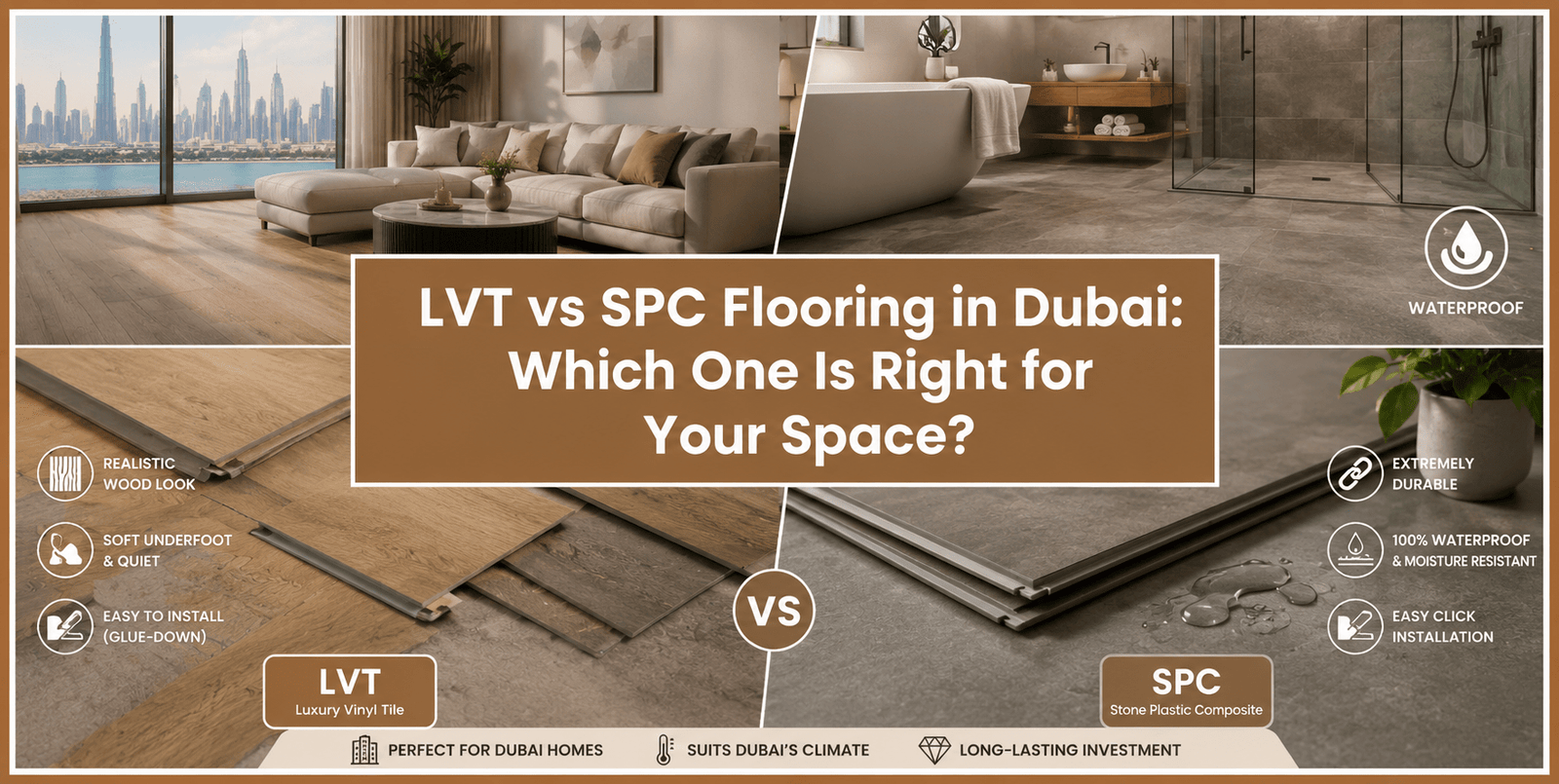
At Floor Mart, our Al Quoz showroom sees dozens of UAE homeowners and interior designers every week who have narrowed their decision down to two products: LVT and SPC flooring. They have done the research. They know both are waterproof, both look like natural wood or stone, and both install without the mess of tile adhesive or the curing delays of traditional flooring methods.
What they cannot easily figure out is which one is genuinely better for their specific situation. Not in general. Not globally. For their Dubai apartment, their Palm Jumeirah villa, their JVC studio renovation, or their Sharjah office refurbishment.
This guide answers that question with the specificity it deserves. By the end, you will know which product is the correct choice for your space, why, and what to check before you buy.
Understanding What LVT and SPC Actually Are
Before comparing them, it is worth being precise about what each product is, because the UAE flooring market uses these terms loosely, and some suppliers use them interchangeably when they should not.
LVT: Luxury Vinyl Tile
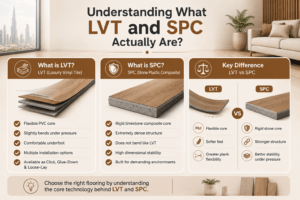
LVT stands for Luxury Vinyl Tile. It is a multi-layer flooring product built primarily from PVC resin. The core of an LVT flooring dubai is flexible, meaning the plank bends slightly when you hold it by the ends. This flexibility is a defining characteristic, not a defect, and it has both advantages and disadvantages in practice.
The typical LVT construction from bottom to top consists of a backing layer for stability, a flexible PVC core, a high-definition printed decorative film, and a transparent wear layer. The wear layer thickness, measured in millimetres, determines how long the surface will resist scratching, abrasion, and everyday wear before showing deterioration.
LVT is available in three distinct installation formats, and this is a critical distinction that most competitor articles skip entirely:
- LVT Click (Floating): Planks connect via tongue-and-groove click mechanism and float over the subfloor without adhesive. Installation is fast and the floor can be used immediately. Suitable for most residential applications.
- LVT Glue-Down (Dry-Back): Planks are adhered directly to the subfloor using pressure-sensitive adhesive. This method is used in commercial settings, large open-plan spaces, and anywhere the subfloor requires the floor to be fully bonded. Installation is more involved and requires careful adhesive application.
- LVT Loose-Lay: Planks use their own weight and a friction backing to stay in place without adhesive or click connections. Used in temporary or rental situations where the floor may need to be removed later.
Understanding which LVT format you are buying matters enormously in the UAE context, because glue-down LVT and click LVT perform differently in high-temperature conditions and require different subfloor preparation standards.
SPC: Stone Plastic Composite
SPC stands for Stone Plastic Composite, sometimes also called Stone Polymer Composite. The core of an SPC Flooring in Dubai is made from a dense mixture of natural limestone powder, polyvinyl chloride, and chemical stabilizers that are compressed together under high heat and pressure. The result is a rigid, extremely dense core that does not bend when you hold the plank by the ends. This rigidity is the defining characteristic of SPC and the root of nearly every performance advantage it has over standard LVT.
SPC is technically a subcategory of the broader LVT family, which is why some suppliers use the terms interchangeably. However, in practice, the rigid stone composite core creates such different performance characteristics that treating them as the same product leads to poor purchasing decisions. For clarity, this guide uses LVT to refer to flexible-core luxury vinyl and SPC to refer to rigid stone composite core vinyl.
The One Difference That Drives Everything Else
Every practical difference between LVT and SPC in a UAE home traces back to one thing: the core. SPC has a rigid, inorganic stone composite core. Standard LVT has a flexible, organic PVC core.
This single structural distinction has downstream effects on dimensional stability, subfloor tolerance, installation method, long-term performance under UAE thermal conditions, and how each product responds to the specific climate stresses of Dubai and Abu Dhabi living.
Dimensional Stability Under UAE Heat
This is the most important performance criterion for Dubai and Abu Dhabi properties, and it is where SPC and flexible LVT diverge most significantly.
Flexible LVT expands and contracts with temperature. In a climate-controlled interior, this is manageable. However, UAE homes experience significant thermal events: slab temperatures on ground floors and podium apartments can exceed 50 degrees Celsius in summer, balcony doors let in rapid heat surges when opened, and properties left unoccupied during summer holidays can reach interior temperatures of 38 to 40 degrees if AC is set to economy mode.
In these conditions, flexible LVT expands along its length and width. Over time, this repeated expansion and contraction causes click-lock joints to loosen, edges to ridge, and planks to shift position. In glue-down LVT applications, extreme heat can soften some adhesives sufficiently to allow plank migration, creating visible gaps or overlaps at joints.
SPC rigid core does not exhibit this behaviour. The limestone composite core is thermally inert. It does not expand when heated and does not contract when cooled. Installations in UAE properties that would cause flexible LVT to fail within two to three summers will still be performing perfectly with SPC a decade later.
Subfloor Tolerance
Flexible LVT is thin and conforms to the subfloor surface beneath it. Any bump, hollow, or variation in the subfloor will telegraph through to the visible surface of the plank. This means flexible LVT requires a near-perfect subfloor preparation before installation. In UAE renovation projects, where the subfloor is often existing ceramic tile with grout lines, this is a significant practical challenge.
SPC rigid core, due to its stiffness, bridges minor subfloor imperfections rather than conforming to them. Grout lines from existing tiles, small surface undulations, and minor height variations of up to approximately 3mm are effectively spanned by the rigid plank without transferring to the visible surface. This makes SPC significantly more forgiving in real-world UAE renovation conditions.
LVT vs SPC: Full Performance Comparison for UAE Properties
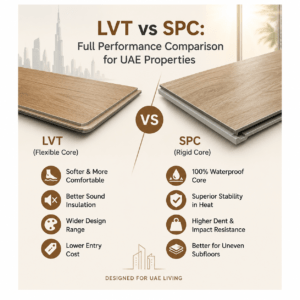
The table below compares LVT and SPC across every criterion that matters specifically to Dubai and Abu Dhabi homeowners. The ratings are calibrated for UAE conditions, not temperate climates.
| Performance Criterion | LVT (Flexible Core) | SPC (Rigid Core) | UAE Verdict |
| Dimensional stability in heat | Moderate: expands in extreme heat | Excellent: thermally inert core | SPC wins clearly |
| Waterproof (core) | Water resistant to waterproof (varies) | 100% waterproof throughout | SPC more reliable |
| Subfloor tolerance | Low: requires near-flat surface | Higher: bridges minor variations | SPC more practical |
| Underfoot comfort | Softer, more cushioned feel | Firmer underfoot | LVT if comfort priority |
| Sound insulation | Good with foam backing | Good with IXPE underlayment | Similar with proper underlay |
| Installation over existing tile | Requires very level tile surface | Can bridge grout line variations | SPC more suitable |
| AC condensation resistance | Moderate | Excellent: inorganic core | SPC preferred |
| Coastal humidity resistance | Good in click format | Excellent | SPC for marina/beach areas |
| Indentation resistance | Moderate: heavy items can dent | High: rigid core resists denting | SPC for heavy furniture |
| Design range | Very wide, including soft patterns | Wide, realistic wood and stone | LVT has broader range |
| Installation speed | Fast (click), slow (glue-down) | Fast (click lock only) | Similar for click formats |
| Cost range UAE (AED/sqft) | 8 to 28 depending on quality | 12 to 35 depending on quality | LVT lower entry point |
| Expected lifespan UAE | 5 to 12 years residential | 10 to 20 years residential | SPC longer term value |
| Suitability for rented properties | Good for short-term / loose-lay | Good for long-term installation | Depends on scenario |
Choosing by UAE Property Type: The Guide No Competitor Provides
Generic flooring comparisons tell you which product is technically superior. What they rarely tell you is how to match the decision to your specific property situation in the UAE. This section addresses the most common UAE scenarios Floor Mart installation teams encounter.
High-Rise Apartments in Dubai Marina, JBR, JVC, and Business Bay
These properties share common characteristics: upper floors with significant AC use, potential for condensation at balcony door junctions, neighbours below who are affected by impact noise, and subfloors that are typically concrete screed or existing tile.
For these properties, SPC flooring with a pre-attached IXPE acoustic underlayment is the correct choice in almost every case. The rigid core handles the thermal cycling from AC operation and occasional heat surges from balcony doors. The acoustic underlayment reduces the impact sound that would otherwise travel to the apartment below. For anyone in a high-rise tower on the marina-facing or sea-facing side, where ambient humidity is significantly higher than inland properties, the inorganic SPC core removes the moisture risk entirely.
Flexible LVT in click format can work in these apartments if the subfloor is perfectly level and the installation includes quality acoustic underlayment. However, the margin for error is smaller, and the expected lifespan in UAE high-rise conditions is lower than SPC in the same application.
Villas in Arabian Ranches, Dubai Hills, Damac Hills, and Al Barsha
Villa properties in these communities typically have ground floors with concrete slab subfloors, first floors over internal spaces, and the thermal characteristics of freestanding construction rather than shared building systems. They also tend to have larger open-plan areas, which means flooring continuity across significant square meterage.
For villa ground floors, SPC flooring is strongly preferred. Ground floor slabs in Dubai can transmit significant heat from the soil beneath during summer months, and the condensation risk at sliding door thresholds to the garden is higher than in any apartment scenario. If you are looking to extend your living space seamlessly to the exterior, choosing the right outdoor flooring that matches your interior aesthetics can elevate the entire villa’s look. SPC handles both internal climate demands and the transition to outdoor environments perfectly.
For villa upper floors, where the subfloor is typically a concrete slab over internal spaces and thermal conditions are more moderate, either SPC or quality click LVT performs adequately. The decision here may reasonably be made on comfort or aesthetic grounds rather than purely performance grounds, which is one of the few scenarios where flexible LVT genuinely competes with SPC on equal terms.
Palm Jumeirah, Bluewaters, and Coastal Properties
These properties experience the highest ambient humidity levels of any residential area in Dubai. The sea air is not just humid in summer; it carries salt particulate that accelerates the degradation of any material with moisture susceptibility. Click-lock joints on flexible LVT that are exposed to this environment over several years can show edge swelling and joint separation that SPC joints in the same location would not.
For coastal properties, SPC is not just preferable, it is the more reliable long-term choice. The 100 percent waterproof, inorganic nature of SPC core means salt air humidity has no effect on the flooring structure. This is particularly relevant for properties with sea-facing balcony doors that are opened regularly for ventilation.
Rental and Tenanted Properties
This is one of the scenarios where flexible LVT deserves a genuine hearing. Property investors who frequently turn over tenancies in Dubai have different requirements from long-term owner-occupiers. The ability to install quickly and at lower cost per square foot matters. The ability to replace a damaged section without demolishing the entire floor matters.
For short-term rental properties and Airbnb units in Dubai where renovation cost is managed tightly and flooring is expected to be replaced every three to five years during refurbishment cycles, entry-level click LVT can be an appropriate choice. It is faster to install, lower in material cost, and adequate for the intended lifespan.
For long-term hold investment properties where the goal is to install once and not revisit the flooring decision for ten to fifteen years, SPC is the better investment even at a higher initial cost per square foot.
Commercial Spaces: Offices, Retail, and Food and Beverage
Commercial applications in the UAE typically require glue-down installation for large open-plan areas to prevent any plank movement under heavy rolling loads and continuous foot traffic. In this context, glue-down LVT has historically dominated commercial flooring in Dubai, and for good reason.
For large commercial areas, glue-down flexible LVT applied with the correct commercial adhesive provides a seamless, fully bonded surface that withstands commercial-grade rolling loads, trolleys, and the continuous foot traffic of retail environments. SPC in click format is not rated for the same level of commercial rolling load resistance because the floating installation allows slight flexion under concentrated loads.
For smaller commercial spaces, boutique offices, and medical clinics where click-lock installation is acceptable, SPC performs well. The rigid core resists the indentation marks that heavy office furniture and medical equipment can leave in flexible LVT.
The Wear Layer Decision: What the Thickness Numbers Actually Mean
Both LVT and SPC are available with wear layers ranging from 0.2mm to 0.7mm or more. This number determines the usable life of the flooring surface and is the most important specification to verify before purchasing either product in Dubai.
In UAE residential conditions, fine silica desert sand enters homes through gaps around doors, window frames, and HVAC systems. This sand, when walked across your floor daily, acts as a continuous fine abrasive against the wear layer surface. A 0.2mm wear layer in a Dubai home will show visible surface dulling within twelve to eighteen months under normal cleaning and foot traffic conditions.
| Wear Layer Thickness | Classification | Suitable For in UAE | Expected Surface Life |
| 0.2mm to 0.3mm | Residential light use | Rarely used bedrooms, guest rooms | 3 to 5 years |
| 0.3mm to 0.5mm | Residential standard | Bedrooms, low-traffic living areas | 5 to 8 years |
| 0.5mm | Residential heavy use | All residential areas, Dubai standard | 8 to 12 years |
| 0.7mm | Semi-commercial | Entryways, high-traffic corridors, kitchens | 12 to 18 years |
| 0.7mm and above | Commercial grade (AC4/AC5) | Retail, offices, commercial kitchens | 15 to 25 years |
A UAE-specific recommendation: the minimum wear layer Floor Mart recommends for any living room or kitchen in Dubai or Abu Dhabi is 0.5mm, regardless of whether the product is LVT or SPC. Any product with a thinner wear layer than this, regardless of how competitive the price appears, is not appropriate for UAE residential conditions.
Installation Realities in UAE Properties: What Actually Happens on Site
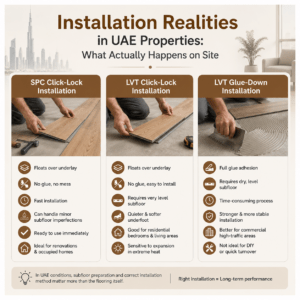
The installation process for LVT and SPC differs in ways that have real practical consequences for UAE renovation projects. Understanding these differences helps you plan your renovation timeline and set realistic expectations for the disruption involved.
SPC Click-Lock Installation
SPC planks in click-lock format are floated over the subfloor without adhesive. The planks connect at their long and short edges via a tongue-and-groove mechanism and are held in place by their own interlocked structure. The installation does not require any adhesive to cure, and the floor can be used immediately after the final plank is laid and skirting boards are replaced.
The most critical step is subfloor preparation. The subfloor must be checked for structural soundness, swept and cleaned of all loose material, and assessed for flatness. Minor variations of up to approximately 3mm across a 1.8 metre span are acceptable for SPC installation. Larger variations require levelling compounds before installation begins.
For a typical 100 square metre apartment in Dubai, an experienced Floor Mart installation team completes the SPC installation in approximately two to three working days, including preparation and skirting replacement.
LVT Click-Lock Installation
LVT click-lock installation follows a similar process to SPC, but the subfloor flatness tolerance is tighter. Because the flexible core conforms to subfloor variations rather than bridging them, any bump or hollow in the subfloor will eventually be visible through the installed plank surface. In older UAE properties with existing tile subfloors, this often requires either grinding down raised grout lines or applying a skim coat of levelling compound over the entire area before LVT is laid.
This additional preparation step adds time and cost to LVT installations in existing UAE properties. It is not always communicated clearly by suppliers who quote attractive material prices without including the full preparation cost.
LVT Glue-Down Installation
Glue-down LVT is installed by applying pressure-sensitive adhesive to the subfloor, allowing it to reach the correct open time, and then pressing planks firmly into position. The process requires skill and experience to achieve consistent adhesive spread and to maintain plank alignment across large areas.
In UAE conditions, adhesive selection matters significantly. Standard adhesive applied in high-temperature conditions can experience accelerated open time, which reduces the working window for installation. Commercial-grade adhesive formulated for hot-climate installation is the correct specification for UAE projects. Ensure your installer is using adhesive that is rated for the temperature range of your specific property.
Glue-down LVT cannot be walked on during the adhesive cure period, which typically requires 24 to 48 hours depending on the adhesive type and ambient temperature. Factor this into your renovation timeline.
Which Should You Choose? A Scenario-by-Scenario Decision Guide
Rather than a single universal answer, use the following scenarios to make the right decision for your specific situation.
Choose SPC When:
- Your property is on a ground floor or above podium parking: Slab heat transfer and condensation risk make SPC the only reliable long-term choice.
- You are in a coastal area or sea-facing property: Ambient humidity levels in Marina, JBR, Palm, and Bluewaters make SPC’s inorganic core the safer option.
- You have existing tile and want to avoid demolition: SPC’s ability to bridge grout line variations makes it more suitable for direct overlay on existing tile floors.
- You have heavy furniture, a home gym, or rolling loads: The rigid core resists indentation marks that flexible LVT will show under sustained point loads.
- You are the owner-occupier and expect to stay long term: The 10 to 20 year lifespan of quality SPC in UAE conditions justifies the higher initial investment.
- Your property is unoccupied for extended periods in summer: SPC is not affected by the elevated interior temperatures that can cause flexible LVT to expand and shift.
Choose LVT When:
- You are renovating a rental property on a tight budget: Entry-level click LVT at a lower AED per square foot is appropriate when you expect to replace the floor in five to seven years anyway.
- Comfort underfoot is the primary priority in a bedroom: The softer, warmer feel of flexible LVT is a genuine advantage in bedrooms where you walk barefoot.
- You need glue-down installation for a large commercial space: Glue-down flexible LVT remains the standard for large commercial open-plan areas and high-traffic retail.
- Your subfloor is already perfectly level and clean: On a flat screed in a new build, LVT’s subfloor sensitivity is not a practical problem.
- You need loose-lay for a temporary installation: For showrooms, exhibitions, and short-term use spaces, loose-lay LVT is a practical option.
An Honest Assessment: Where Does SPC Fall Short?
Most articles comparing LVT and SPC in the UAE are written to sell one product or the other. Floor Mart position is that honest advice builds longer-term client relationships than overselling, so here is where SPC genuinely underperforms relative to flexible LVT.
Underfoot Feel
SPC is firmer to stand on than flexible LVT of comparable thickness. For homeowners who have converted from carpet or soft vinyl and are standing in a kitchen for extended periods, this firmness is noticeable. An IXPE or cork underlayment reduces this, but SPC will always feel firmer than a flexible LVT product of equivalent thickness.
Entry-Level Cost
The entry price point for acceptable-quality SPC in the UAE market is higher than the entry price for LVT. Budget-conscious renovation projects, particularly in short-lease rental properties, may find that even basic LVT meets their actual performance requirements at a meaningfully lower material cost.
Plank Replacement
Because SPC uses click-lock installation without adhesive, individual damaged planks can theoretically be replaced by unclicking back to the affected area. In practice, this is rarely straightforward in fully furnished rooms. The same constraint applies to click LVT. However, glue-down LVT in a commercial setting allows damaged sections to be cut out and replaced more surgically than any floating floor system.
Weight
SPC planks are denser and heavier than LVT planks of the same size. In a high-rise apartment building with load-rated floor structures, this is almost never a practical concern for residential installation. However, for very large commercial projects where cumulative dead load matters, the structural engineer’s specification takes precedence over the flooring preference.
Maintaining LVT and SPC Flooring in UAE Homes
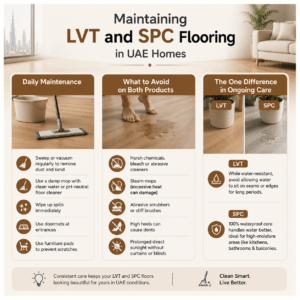
Both LVT and SPC require similar maintenance routines, but there are UAE-specific considerations worth noting for each.
Daily Maintenance
For both LVT and SPC, the most important daily habit in a UAE home is dry cleaning before wet cleaning. Fine desert sand that settles on the surface acts as an abrasive when a damp mop is dragged across it. Dry mopping or vacuuming with a soft brush head first removes the abrasive layer, and wet mopping with a well-wrung, pH-neutral cleaner then cleans the surface without the abrasive action that shortens wear layer life.
What to Avoid on Both Products
- Steam mops: The localized high heat of steam damages both LVT and SPC wear layers and can cause edge separation on flexible LVT planks over time.
- Abrasive cleaners: Powdered cleaning products and anything with an abrasive grit compound should never be used on either product.
- Flooding: While both products are waterproof, large volumes of water sitting on any floor for extended periods should be removed promptly to prevent water from reaching the wall junction where the expansion gap is located.
The One Difference in Ongoing Care
Flexible LVT in very high-temperature locations, such as direct sunlight near south-facing windows or glass walls in Business Bay offices, can show surface bubbling or edge lifting if the product has not been installed with adequate expansion gaps. If you notice any planks beginning to ridge at the edges, check whether the expansion gap has been installed correctly before assuming a product defect. This is an installation issue, not a product failure, and it affects flexible LVT more than rigid SPC.
Frequently Asked Questions: LVT vs SPC in Dubai
Is SPC flooring actually the same as LVT flooring?
Technically, SPC is a type of LVT, which is why the terms are sometimes used interchangeably by suppliers. In practice, the rigid stone composite core of SPC creates such different performance characteristics, particularly in UAE thermal conditions, that treating them as identical products leads to poor purchasing decisions. This guide uses LVT to mean flexible-core vinyl and SPC to mean rigid stone composite core vinyl, because the distinction is meaningful for UAE homeowners.
Can I use LVT in my Dubai bathroom?
Click-format LVT that is rated as waterproof can be used in bathrooms, provided the perimeter is sealed with silicone at the wall junction and around all floor penetrations. The click-lock joint itself is not waterproof. The perimeter sealing creates the waterproof barrier. For bathrooms, SPC is the more reliable choice because the inorganic core eliminates any moisture absorption risk at the core level, whereas some LVT products with non-waterproof core ratings can absorb moisture at cut edges.
Which is easier to install over existing tiles in a UAE apartment?
SPC is significantly easier to install over existing UAE tile floors than flexible LVT. SPC’s rigid core bridges the grout lines of existing tile without telegraphing them to the surface, whereas flexible LVT will eventually show the grout line pattern through the plank surface if laid directly over grouted tile. For overlay installations, SPC is the preferred choice.
What is the most common mistake UAE buyers make when choosing between LVT and SPC?
The most common mistake is choosing based on price per square foot without accounting for the total cost of installation, including subfloor preparation, and the expected lifespan in UAE conditions. An LVT product that costs 15 percent less per square foot but requires additional levelling compound preparation and lasts five years shorter in UAE conditions is not the more economical choice when total cost of ownership is calculated.
Does SPC flooring feel cold underfoot in UAE winter months?
UAE winters are mild compared to European or North American winters, and interior temperatures in climate-controlled properties rarely fall below 18 to 20 degrees Celsius even in the coldest months of December and January. At these temperatures, the underfoot feel of SPC is comfortable without additional measures. For anyone who finds tile floors uncomfortably cold in UAE winter, both SPC and LVT will feel significantly warmer underfoot than ceramic or porcelain tile.
How do I verify the wear layer thickness before buying?
Ask the supplier to provide the product datasheet or EN standards compliance certificate, which will specify the wear layer thickness in millimeters and the AC rating. AC3 corresponds to approximately 0.3mm and is classified for residential use. AC4 corresponds to approximately 0.5mm and is classified for residential heavy use and light commercial. AC5 corresponds to 0.7mm and above and is classified for commercial use. In the UAE, AC4 is the minimum recommended for any living room or kitchen, and AC3 products should be reserved for very low-traffic applications only.
The Bottom Line: Which Floor Does Floor Mart Recommend for UAE Homes in 2026?
SPC flooring is better choice for UAE homes residential properties due to its superior performance in extreme climate conditions. Its rigid core offers better thermal stability, moisture resistance, and tolerance for uneven subfloors, making it ideal for long-term use. These advantages result in more reliable outcomes over 5–15 years. However, LVT remains suitable for specific cases like budget rentals, bedrooms needing extra comfort, glue-down commercial projects, and temporary spaces. The right decision depends on property type and usage needs. Floor Mart offers both options, helping customers choose based on subfloor condition, location, and renovation goals.