Scroll through any interior design page and you’ll spot them everywhere — those striking zigzag floor patterns that instantly make a room feel more expensive. But ask most people to tell herringbone and chevron apart, and they’ll struggle. At a glance, the two look almost identical. Look closer, though, and they’re built on completely different logic — and that difference affects everything from cost to how the pattern will actually look in your space.
Here’s a clear, practical breakdown of herringbone vs chevron flooring, so you can choose the one that actually fits your home.
What Is Herringbone Flooring?
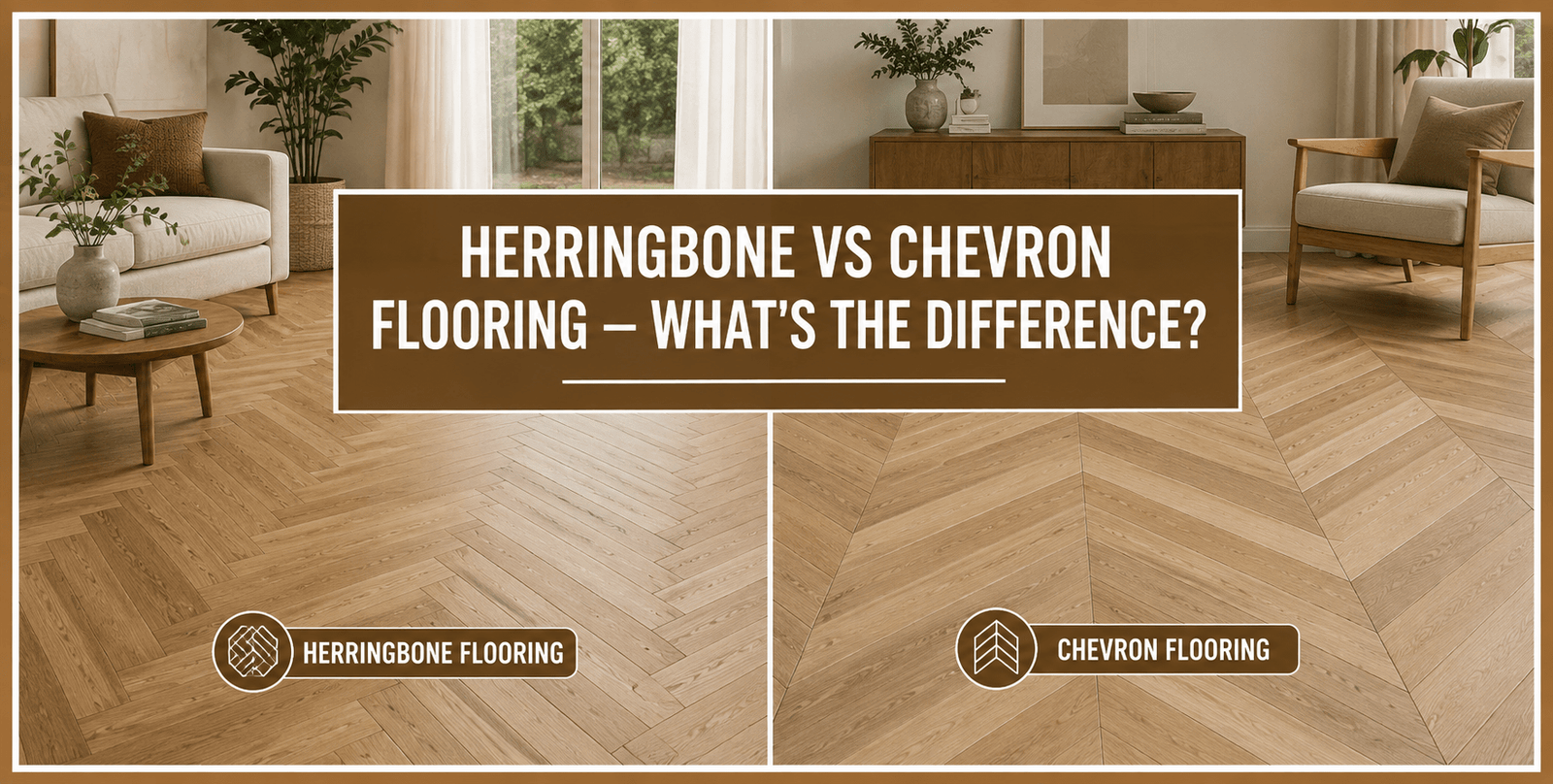
Herringbone Flooring is made from rectangular planks or tiles, all cut to the exact same size, arranged at 90-degree angles to one another. The short end of each plank sits flush against the long side of the next, creating a broken, staggered zigzag. The joints don’t line up — that’s actually the defining feature of the pattern, and it’s what gives herringbone its layered, textured look.
The name comes from its resemblance to the skeleton of a herring fish, and the pattern itself dates back to Roman times, when it was used to pave roads because the interlocking shape distributed weight so well. It later became a signature look in European wood flooring from the 16th century onward, and it’s stayed popular ever since.
What Is Chevron Flooring?
Chevron looks similar at first glance but is built very differently. Each plank is cut at an angle — usually 45 degrees — and the planks meet point-to-point, forming a continuous, unbroken V-shape. Unlike herringbone’s staggered joints, chevron’s lines flow seamlessly across the floor in a single, uninterrupted arrow pattern.
Because of that precise angled cut, chevron requires far more accuracy during manufacturing and installation. Even a small misalignment throws off the whole line, which is why chevron planks are often pre-cut and sold specifically for this layout, rather than adapted from standard rectangular planks.
The Core Difference, in One Line
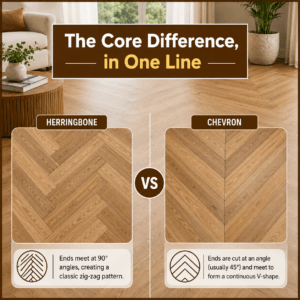
Herringbone = rectangular planks, 90-degree angles, broken zigzag with staggered joints. Chevron = angle-cut planks, meeting point-to-point, continuous unbroken V-shape.
That one construction difference is the reason everything else — look, cost, installation difficulty, and even room suitability — plays out differently between the two.
Visual Difference: Which Looks Like What?
- Herringbone has a busier, more textured, more traditional feel. The staggered joints create visual movement and depth, and the pattern tends to make smaller rooms feel larger and more dynamic.
- Chevron has a cleaner, bolder, more graphic look. The continuous V-lines create a strong sense of direction and flow, giving spaces a more modern, streamlined, architectural feel.
If you want a floor that feels classic, layered, and a little more forgiving visually — herringbone. If you want a floor that makes a sharp, confident design statement — chevron.
Installation Difficulty and Cost
This is where the two patterns really diverge.
Herringbone is generally easier and faster to install. Since it uses standard rectangular planks at consistent 90-degree angles, the layout is more predictable and more forgiving around borders, corners, and awkward room shapes.
Chevron is more demanding. The precision-cut angled ends have to align perfectly at every joint, or the entire pattern loses its clean line. This takes more skill, more time, and typically produces more material waste during cutting — all of which adds to labour and material costs. As a rough guide, chevron installations often run noticeably higher than herringbone for a comparable space, mainly due to the precision cutting and higher waste factor.
Which Rooms Suit Each Pattern?
Herringbone works well in:
- Smaller or irregularly shaped rooms, where its broken pattern adapts more naturally around corners
- Traditional or transitional interiors
- Spaces where you want visual texture without an overly bold statement
- Homes with more relaxed budgets for pattern flooring, since it’s typically the more cost-effective of the two
Chevron works well in:
- Larger, open rooms where the continuous lines have space to flow uninterrupted
- Modern or contemporary interiors looking for a strong architectural feature
- Entryways, living rooms, or feature areas meant to make a statement
- Projects where budget allows for the extra precision and labour involved
In smaller spaces, chevron’s bold directional lines can sometimes feel busy or overwhelming, while herringbone tends to scale more comfortably across different room sizes.
Herringbone vs Chevron: Quick Comparison
| Factor | Herringbone | Chevron |
| Plank cut | Rectangular, cut at 90 degrees | Angle-cut, typically at 45 degrees |
| Joint pattern | Staggered, broken zigzag | Continuous, point-to-point V-shape |
| Visual style | Textured, layered, traditional | Clean, bold, graphic, modern |
| Installation difficulty | Easier, more forgiving | More demanding, needs precise alignment |
| Material waste | Lower (10–15%) | Higher (15–20% or more) |
| Overall cost | Generally more affordable | Generally 10–30% more expensive |
| Best room size | Works well in smaller or irregular rooms | Shines in larger, open spaces |
| Interior style fit | Traditional and contemporary | Primarily modern and contemporary |
| Available materials | Hardwood, engineered wood, laminate, LVT | Hardwood, engineered wood, laminate, LVT |
Does It Matter Which Flooring Material You Use?
Both patterns can be created in a range of materials — solid hardwood, engineered wooden flooring, laminate, and LVT (Luxury Vinyl Tile). The pattern logic stays the same regardless of material, but the material itself changes how practical the floor is for your space.
For homes in hot, humid climates like Dubai, choosing the right flooring dubai options—such as herringbone and chevron patterns in LVT or engineered wood—holds up far better than solid hardwood. They are less prone to warping or expansion from heat and humidity while still delivering the same striking pattern.
Frequently Asked Questions
Is herringbone or chevron more expensive?
Chevron is generally more expensive than herringbone, often by a noticeable margin. This comes down to the precision angle-cutting required, higher material waste, and the extra skill and time needed for accurate installation.
Which pattern is easier to install, herringbone or chevron?
Herringbone is easier to install. It uses standard rectangular planks at consistent 90-degree angles, making the layout more predictable, while chevron’s angled joints require exact alignment at every point.
Does herringbone or chevron flooring make a room look bigger?
Herringbone is often considered better at making smaller or irregular rooms feel larger, thanks to its layered, staggered visual movement. Chevron tends to shine in larger, open spaces where its continuous lines have room to flow.
Can I get herringbone or chevron patterns in vinyl or LVT flooring?
Yes. Both patterns are widely available in LVT and engineered wood, which offer the same visual impact as solid hardwood but with better resistance to heat, humidity, and daily wear — a practical advantage in climates like Dubai’s.
Which pattern suits a modern interior better?
Chevron is generally considered the more modern, graphic option thanks to its clean, continuous V-lines. Herringbone works well in both traditional and contemporary interiors, making it the more versatile choice stylistically.
Do herringbone and chevron flooring require special maintenance?
Not beyond standard care for whichever material you choose. The pattern itself doesn’t add maintenance requirements — cleaning and upkeep depend on whether the flooring is hardwood, engineered wood, laminate, or LVT.
Final Thoughts
Herringbone and chevron both bring a level of visual interest that flat plank flooring simply can’t match — but they achieve it in different ways. Herringbone offers a more textured, versatile, and budget-friendly option that adapts well to almost any room. Chevron delivers a bolder, more architectural statement, best suited to larger spaces and interiors that can accommodate its higher cost and precision installation.
There’s no universally “better” choice here — it comes down to the look you want, the size and shape of your space, and your budget.
Considering a patterned floor for your home? Floor Mart offers herringbone and chevron flooring in LVT and engineered wood options suited to Dubai homes, along with expert installation to get every joint and angle right. Get in touch for a free consultation and quote.