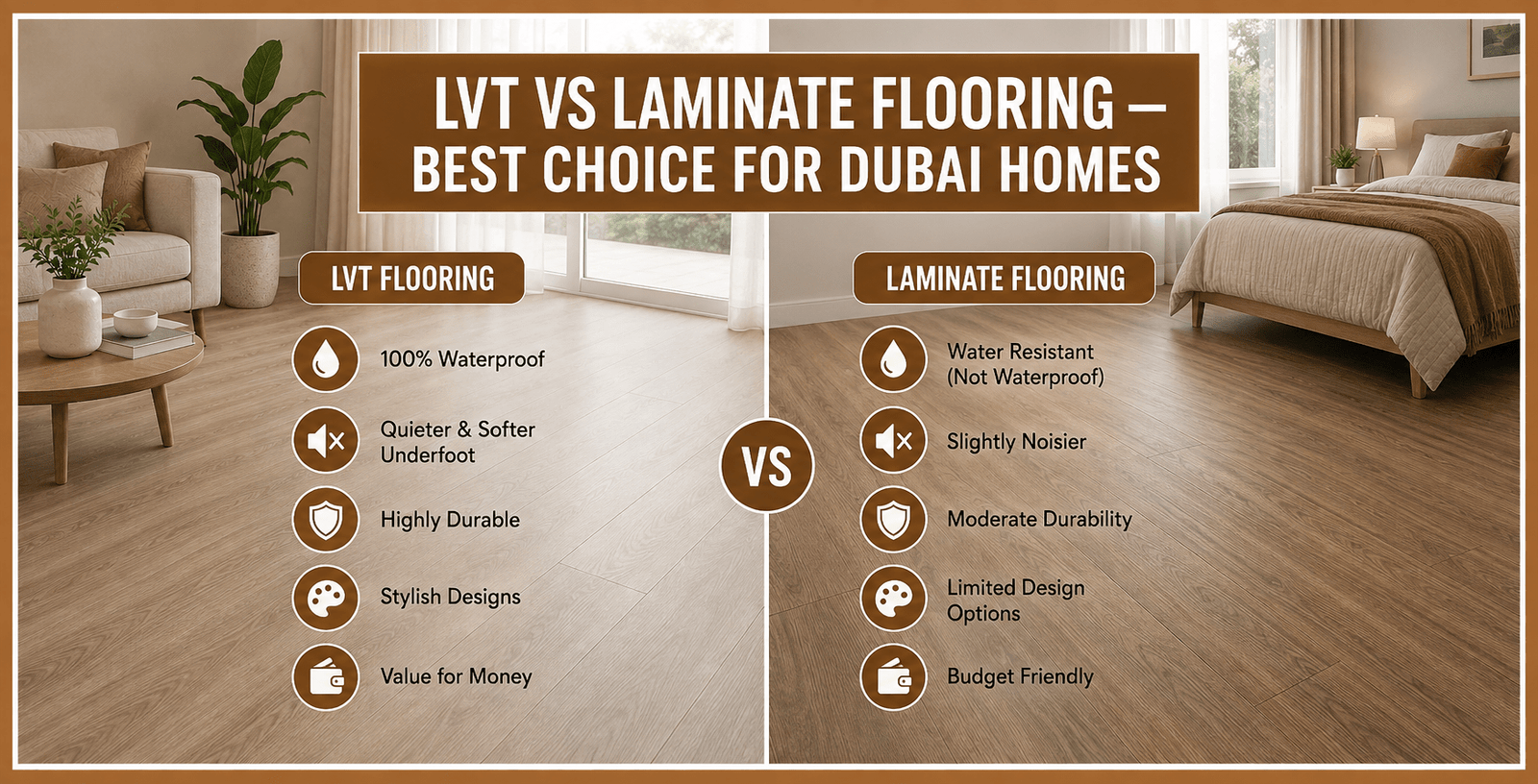
Standing in a flooring showroom trying to decide between LVT and laminate? You’re not alone. These two are constantly compared because, at first glance, they look almost identical — both mimic wood or stone, both come in click-lock planks, both promise an easy installation. But once you factor in Dubai’s climate, daily lifestyle, and long-term value, the differences start to matter a lot more than the showroom samples suggest.
This guide compares LVT and laminate flooring side by side, specifically through the lens of what actually works for flooring in Dubai..
What’s the Real Difference Between LVT and Laminate?
LVT (Luxury Vinyl Tile)
is a fully synthetic flooring product. It’s built from layers of PVC or a rigid SPC/WPC core, topped with a high-definition print layer and a protective wear layer. Nothing inside it is made from wood, which is exactly why it holds up so well around moisture.
Laminate flooring
looks similar on the surface but is built very differently underneath. Its core is made from high-density fiberboard (HDF), a compressed wood byproduct, topped with a photographic layer and a protective coating. Because the core contains wood fibre, laminate flooring is naturally more vulnerable to swelling, warping, or bubbling when it comes into repeated contact with water.
That one structural difference — synthetic core vs wood-based core — is the root of almost every other difference between the two.
Water and Humidity Resistance
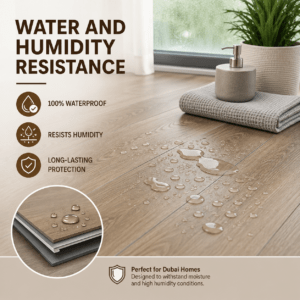
This is usually the deciding factor for Dubai buyers, and it’s not a close contest.
- LVT Flooring is fully waterproof at the plank level. It can handle spills, mopping, humidity, and even standing water for short periods without swelling or losing its shape.
- Laminate is, at best, water-resistant — meaning it can survive a quickly wiped-up spill, but prolonged moisture exposure will eventually cause the HDF core to swell or the edges to bubble.
In a city where humidity fluctuates seasonally, AC units create condensation, and open-plan kitchens sit right next to living spaces, this difference alone pushes many homeowners toward LVT for anything beyond a bedroom or study.
Heat and Temperature Stability
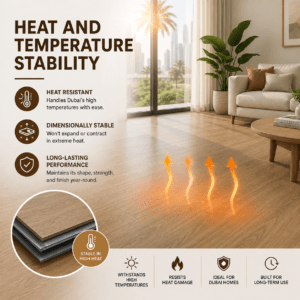
Dubai’s climate doesn’t just bring humidity — it brings extreme heat, and that has its own effect on flooring.
Rooms cooled to a steady 22°C during the day, combined with AC systems switched off for weeks during travel season, put continuous expansion-and-contraction stress on flooring materials. Large glass windows can also create sharp temperature differences between the sunny and shaded parts of the same room.
Rigid-core LVT (SPC pattern in particular) tends to have better dimensional stability under these swings than laminate, meaning less risk of gapping, peaking, or warping at the seams over time.
Durability and Daily Wear

Both flooring types are reasonably durable for normal household use, but they hold up differently under different kinds of stress:
| Factor | LVT | Laminate |
| Water/moisture | Fully waterproof | Water-resistant only |
| Heat stability | Very good (especially SPC core) | Moderate |
| Scratch resistance | Good, protected by wear layer | Very good, often slightly harder surface |
| Feel underfoot | Warmer, softer, quieter | Firmer, can feel hollow underfoot |
| Best for | Kitchens, bathrooms, villas, high-humidity areas | Bedrooms, living rooms, dry indoor spaces |
Laminate actually edges out LVT slightly on raw scratch resistance in some product lines, since its top coating is often very hard. But that advantage matters less if the room in question has any real moisture exposure.
Cost Comparison
Laminate is generally the more budget-friendly option upfront, while LVT sits at a higher price point due to its waterproof core and longer expected lifespan. The gap isn’t usually enormous, though — and many homeowners find that LVT’s lower long-term maintenance and repair costs help close that gap over the years, especially in rooms exposed to moisture where laminate would need earlier replacement.
If budget is tight and the flooring is going into a genuinely dry room — a bedroom, home office, or formal living area with no water exposure — laminate remains a perfectly reasonable choice.
Installation and Maintenance
Both LVT and laminate are typically installed as floating floors with a click-lock system, so installation timelines are similar. Where they differ is in long-term maintenance:
- LVT needs only regular sweeping and damp mopping. There’s no risk of water damage from normal cleaning.
- Laminate needs a bit more caution — damp mopping is fine, but standing water or steam cleaning should be avoided, and spills should be wiped up quickly to prevent moisture from reaching the seams.
Which One Should You Choose for Your Dubai Home?
Choose LVT if:
- You’re flooring a kitchen, bathroom, laundry room, or any space near water
- Your home has an open-plan layout where moisture can travel between rooms
- You want a floor that performs consistently through Dubai’s heat and humidity without special care
- You’re looking for the best long-term value, even with a higher upfront cost
Choose laminate if:
- You’re flooring a bedroom, study, or formal living room with minimal moisture exposure
- You want a more budget-friendly option and can commit to careful maintenance
- Scratch resistance from pets or heavy furniture is your top concern in a dry space
For most Dubai homes — where kitchens open into living areas, humidity shifts with the seasons, and villas often have moisture near gardens or pools — LVT tends to be the more practical, lower-maintenance investment across the whole home. Laminate still has its place in strictly dry, low-traffic rooms, but it’s worth being realistic about where those rooms actually are in a typical Dubai layout.
Frequently Asked Questions
Is LVT more expensive than laminate flooring in Dubai? Yes, generally. LVT sits at a higher price point upfront because of its waterproof core and longer lifespan, while laminate is usually the more budget-friendly choice. Over time, though, LVT’s lower maintenance and repair needs — especially in humid or high-traffic areas — can help balance out that initial cost difference.
Can laminate flooring be used in a Dubai kitchen or bathroom? It’s not recommended. Laminate’s HDF core is water-resistant at best, not waterproof, so repeated spills or humidity in kitchens and bathrooms can eventually cause swelling or bubbling at the seams. LVT is the safer choice for these rooms.
Does LVT feel as good as laminate underfoot? Most people find LVT slightly warmer and quieter to walk on, especially WPC-core options. Laminate tends to feel a bit firmer and can sound hollow in some installations, though this varies by underlayment.
Which flooring lasts longer in Dubai’s climate? LVT generally has the edge here. Its synthetic core handles humidity and temperature swings — including AC cycling and strong sun exposure through large windows — with better dimensional stability than laminate’s wood-based core.
Is laminate a bad choice overall, or just for certain rooms? Laminate isn’t a bad flooring option — it’s simply better suited to dry, low-traffic spaces like bedrooms, studies, or formal living rooms. In those rooms, it can be a practical, budget-friendly choice that performs well for years.
Can I install LVT over my existing laminate floor? In many cases, yes, provided the existing floor is flat, stable, and in good condition. It’s best to have a professional assess the subfloor first, since uneven or damaged laminate underneath can affect how well the new LVT locks and lies.
Do LVT and laminate require different cleaning routines? Both are low-maintenance, but LVT is more forgiving. It can be damp-mopped freely without concern. Laminate needs a bit more care — avoid steam mops and standing water, and wipe up spills quickly to protect the seams.
Final Thoughts
Both LVT and laminate can give you a beautiful, wood- or stone-look floor. The real decision comes down to where the flooring is going and how much moisture that space will realistically see. In Dubai’s climate, that usually tips the scale toward LVT — especially for kitchens, bathrooms, and any open-plan area connected to them.
Not sure which is right for your space? Floor Mart supplies and installs both LVT and laminate flooring across Dubai homes and offices, and can help you choose the right option room by room based on your budget and lifestyle. Get in touch for a free consultation and quote.