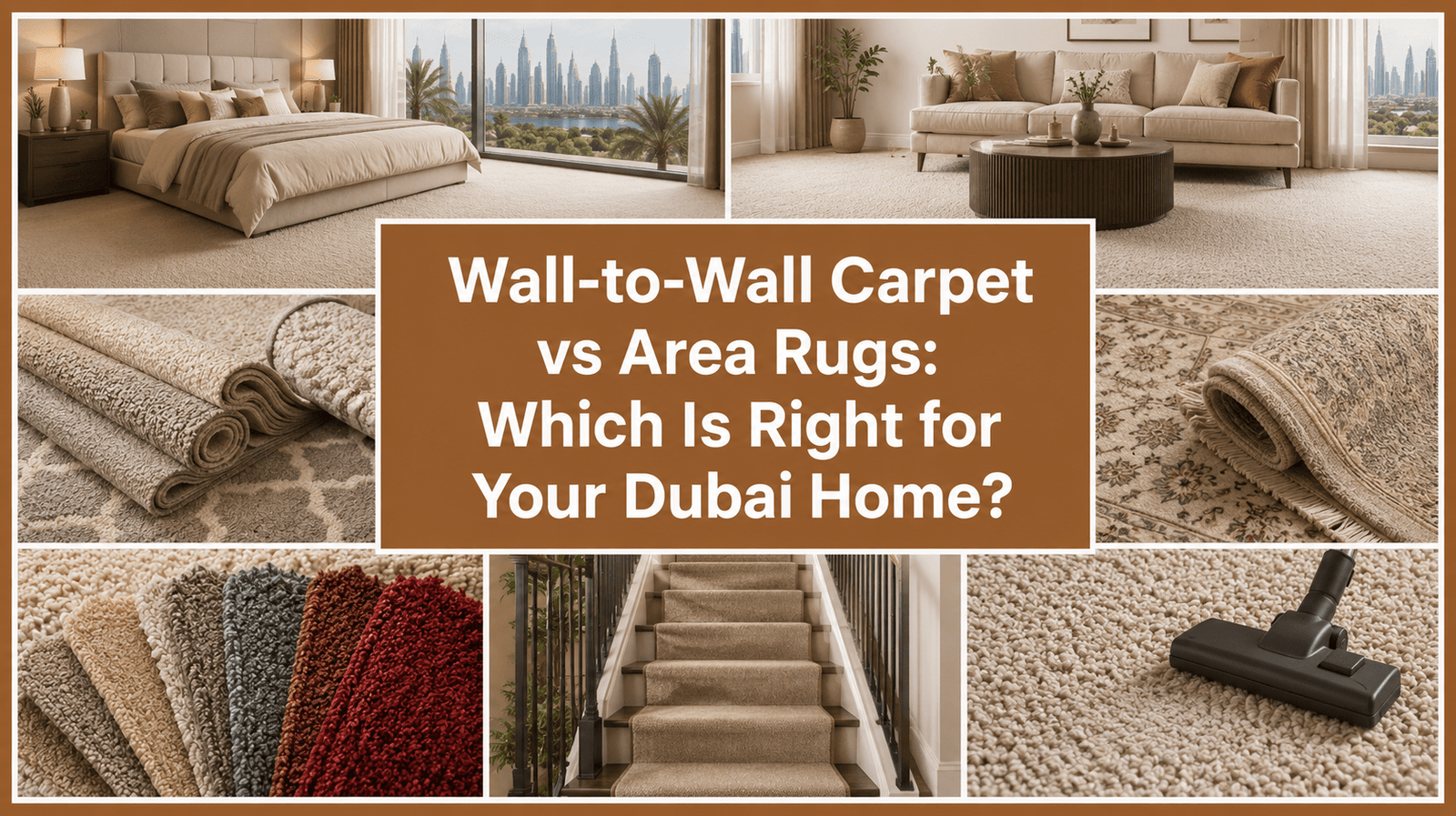
Choosing between a wall-to-wall carpet and an area rug is one of the most important flooring decisions for Dubai homes. While both add comfort and style, they serve different purposes depending on your room, property, and lifestyle. Making the wrong choice can lead to unnecessary costs and inconvenience. This guide from Floor Mart explains the key differences, helping you select the best flooring solution for your Dubai home in 2026.
Understanding the Fundamental Difference
Before comparing performance, comfort, and cost, it helps to be precise about what each option actually is, because the two products serve architecturally different purposes even though they look superficially similar.
Wall-to-Wall Carpet: Permanent Floor Coverage
Wall-to-wall carpet, also called broadloom carpet or fitted carpet, is a textile floor covering that is cut to the exact dimensions of a room and professionally installed using gripper rods along the perimeter, with an underlay layer beneath. It covers the entire floor surface from wall to wall with no visible gap or break. Once installed, it functions as the floor itself rather than as a furnishing placed on top of a floor.
Wall-to-wall carpet is a semi-permanent installation decision. Removing it later involves pulling up the fitted carpet, removing the gripper rods from the perimeter, and dealing with the underlay, which may leave adhesive residue or minor surface marks on the subfloor underneath. It is not a quick change, and in a rented Dubai apartment, it typically requires landlord permission before installation.
Area Rugs: Flexible, Furniture-Defined Coverage
An area rug is a pre-sized textile piece that sits on top of an existing floor surface without any permanent fixing. It can be rolled up, repositioned, moved between rooms, taken to a rug cleaning service, or replaced entirely without any impact on the floor beneath. In Dubai homes, area rugs are placed over tile, porcelain, marble, SPC flooring, engineered wood, or even existing wall-to-wall carpet to add softness, define a seating zone, or introduce colour and texture into a space.
Area rugs range from small accent pieces under a coffee table to large statement rugs that cover most of a room’s floor area, stopping approximately 40 to 60 centimetres short of the walls. The key distinction is that the floor beneath remains intact and visible at the perimeter.
Wall-to-Wall Carpet vs Area Rugs: Full Comparison for UAE Homes
| Factor | Wall-to-Wall Carpet | Area Rug | UAE Context |
| Installation | Professional fit required, semi-permanent | No installation, place and use | W-t-W needs landlord approval in rentals |
| Coverage | Full floor, no visible subfloor | Partial, perimeter floor visible | W-t-W better for acoustic insulation |
| Acoustic performance | Excellent: full room sound absorption | Good in covered area only | W-t-W superior in high-rise apartments |
| Flexibility | Fixed once installed | Move, replace, or remove freely | Rugs better for renters or frequent redesigns |
| Cleaning method | Vacuum + professional deep clean in place | Vacuum + remove and wash or send out | Rugs easier to deep clean in Dubai heat |
| Spill response | Spot clean only, stains can set | Remove immediately, clean thoroughly off-floor | Rugs more practical with kids and pets |
| Cost entry point | Medium to high (material + labour) | Wide range from low to very high | Budget rugs available; W-t-W has installation floor cost |
| Long-term value | Adds permanence and uniform finish | Investment pieces hold or gain value | Persian/wool rugs appreciate; W-t-W depreciates |
| Room definition | Covers entire room uniformly | Defines zones in open-plan spaces | Rugs ideal for large open-plan Dubai villas |
| Suitability for tile floors | Replaces tile feel entirely | Adds softness while keeping tile | Common in Dubai where tile is standard base |
| Allergy considerations | Traps dust across entire floor area | Traps dust in specific area only | Easier allergen control with area rug |
| Customisation | Cut to exact room shape and size | Pre-made sizes or custom order | W-t-W better for irregular room shapes |
Room-by-Room Decision Guide for Dubai Homes
The right choice between wall-to-wall carpet and an area rug is not the same for every room. Each space in a UAE home presents different priorities, and the answer changes based on who uses the room, how it is used, and what the floor beneath currently looks like.

Master Bedroom
The master bedroom is where wall-to-wall carpet delivers its most compelling case in a Dubai home. The moment your feet leave the bed and meet a soft, warm surface rather than cold tile at 6 in the morning is something that a rug, no matter how large, cannot fully replicate, because a rug will not cover the floor directly beside the bed on all sides, or the path between the wardrobe and bathroom door.
Full wall-to-wall coverage in a master bedroom also creates a visual calm and uniformity that a rug on tile cannot match, and the acoustic effect, absorbing the sound of movement and reducing echo in what is typically the room where silence matters most, is significantly stronger with fitted carpet than with a partial rug.
Floor Mart’s wall-to-wall range, from the entry-level Atticus through to the premium Diamond and Luna designs, gives master bedroom installations in Dubai a practical starting point across different budget levels.
Children’s Bedrooms
Children’s bedrooms present a genuine trade-off that depends on the age of the child and how actively the room is used. For younger children who spend significant time playing on the floor, the full soft coverage of wall-to-wall carpet eliminates the hard tile risk for tumbles and provides a comfortable play surface across the entire room rather than just where the rug sits.
However, children’s rooms are also higher spill and accident risk environments than any other room in a Dubai home, and wall-to-wall carpet that absorbs a significant liquid spill is substantially harder to recover than an area rug that can be removed, taken outside, and thoroughly cleaned or replaced. For older children with a clearly defined desk and bed area, a large area rug over tile may be the more practical long-term choice.
Living Room and Majlis
The living room and majlis are where area rugs typically outperform wall-to-wall carpet in Dubai homes, not because wall-to-wall is unsuitable, but because of how open-plan UAE living spaces function.
Large open-plan living and dining areas, which are standard in Dubai villas and many modern apartments, benefit from zoning: distinct visual areas that define where the seating arrangement begins and where the dining space starts. A large area rug under the sofa and coffee table creates this zone without requiring the entire floor to be carpeted, and it works beautifully with the tile or marble flooring that most Dubai living rooms have as their base.
A key advantage for the living room is that a quality area rug, particularly a wool or natural fibre piece, functions as an investment in the room’s character that can be moved or upgraded without touching the floor. Wall-to-wall in a living room, by contrast, requires a more considered commitment, since the colour and texture choice becomes a fixed background for the entire room’s decor scheme.
Dining Room
The dining room is one of the clearest cases for an area rug over wall-to-wall carpet in a UAE home. Wall-to-wall carpet in a dining room, while not impossible to maintain, creates ongoing cleaning challenges because food and liquid spills in a dining area are frequent rather than occasional. A quality flatweave or low-pile area rug under the dining table can be removed for cleaning far more practically than fitted carpet in the same location.
For the dining room rug to function correctly, it must extend far enough beyond the edges of the table that dining chairs remain on the rug even when pulled out for seating. A standard Dubai dining table of 180 to 200 centimetres in length typically requires a rug of at least 280 to 300 centimetres in the corresponding dimension to achieve this.
Home Office
Home offices in Dubai apartments and villas benefit significantly from sound management, particularly in high-rise buildings where ambient building noise, footfall from above, and acoustic echo in hard-floored rooms can disrupt concentration and video call clarity. Wall-to-wall carpet in a home office addresses all of these simultaneously, covering the full floor area and absorbing sound across the entire room rather than just beneath a desk rug.
For home offices in rented properties where wall-to-wall installation is not permitted, a large, medium-pile area rug covering most of the floor area offers a reasonable acoustic improvement. Loop pile options, which are firmer underfoot and more resistant to the rolling of office chair castors, are the practical choice for a rug in a home office setting.
Prayer Room or Majlis
Prayer rooms and dedicated majlis spaces in UAE villas are among the most traditional applications for quality carpet in Gulf homes, and this is one area where full wall-to-wall coverage has a clear cultural and practical logic. A prayer room with complete carpet coverage from wall to wall creates a uniform, clean, and dedicated floor surface that defines the space as set apart from the rest of the home. Sisal and natural fibre options from Floor Mart’s Carpets Dubai collection, including the Tasmania sisal blend, also work well in prayer room applications where a textured, natural material aesthetic is preferred.
Corridors and Entryways
Corridors and entryways are where stair runners Carpets and fitted carpet deliver a very specific advantage over area rugs: safety. An area rug in a hallway or corridor, no matter how thick the non-slip pad underneath, carries a trip and slide risk that does not exist with fitted carpet secured to gripper rods at the perimeter. In a Dubai home with elderly residents or young children, fitted carpet in corridors is a meaningful safety improvement over any area rug alternative.
Owner-Occupier vs Tenant: The Decision Changes Completely
One of the most important factors in the wall-to-wall versus area rug decision in Dubai is your relationship to the property. This is a consideration almost no competitor article addresses directly, yet it is practically decisive for a large proportion of Dubai’s residential population, where a significant number of residents are tenants rather than owner-occupiers.
If You Own Your Property
Wall-to-wall carpet installation is entirely within your control and is a reasonable long-term investment in rooms where the performance advantages of fitted carpet, acoustic insulation, full floor softness, and uniform visual finish, outweigh the commitment involved. The Floor Mart wall-to-wall collection with professional installation is the appropriate route for bedrooms, home offices, and prayer rooms where full coverage adds genuine value over the long ownership period.
Area rugs are also a valuable addition for an owner-occupier, particularly in living rooms, dining rooms, and open-plan spaces where zoning and flexibility are more useful than full fitted coverage.
If You Are a Tenant in a Dubai Apartment or Villa
Wall-to-wall carpet installation in a rented property requires explicit written permission from the landlord in almost all cases, because the installation involves fixing gripper rods to the perimeter of the floor and cutting the carpet to fit the room. If the landlord does not permit permanent modifications and you proceed without permission, you may be liable for restoring the original floor condition at the end of the tenancy, which adds cost.
For Dubai tenants, high-quality large area rugs are the practical solution for adding softness, warmth, and acoustic improvement to rooms that have tile or hard flooring. A well-chosen area rug in a bedroom or living room transforms the feel of a rented apartment without any landlord approval requirement, and it leaves with you when you move to the next property.
Layering Rugs Over Wall-to-Wall Carpet
This is the option that most Dubai flooring guides mention briefly and then move on from, but it deserves proper attention because it is genuinely effective in the right context.
Rug layering, placing a quality area rug on top of an existing wall-to-wall carpet, is not a design compromise or a budget workaround. In contemporary Dubai interior design, layering a statement rug such as a Persian piece, a Moroccan flatweave, or a natural jute rug over a neutral fitted carpet creates a depth of texture and visual richness that neither product achieves alone.
The wall-to-wall carpet provides the acoustic foundation, the full floor softness, and the temperature-moderating effect across the entire room. The area rug placed over it defines the seating zone, introduces pattern and colour, and gives the room a layered, considered quality that a single surface covering cannot achieve.
For this to work well, the base wall-to-wall carpet should be relatively low-pile and in a neutral colour, so the area rug sits level without the base carpet pushing up at the edges, and the layered rug’s pattern and colour read clearly against the neutral background beneath.
Area Rug Sizing Guide for Dubai Rooms
One of the most common mistakes with area rugs in Dubai homes is selecting the wrong size. A rug that is too small for the room makes the furniture arrangement look unanchored and the space feel smaller than it is. The sizes below are practical guidelines based on standard UAE room configurations.
| Room / Application | Minimum Rug Size | Recommended Size | Key Sizing Rule |
| Small bedroom (single bed) | 160 x 230 cm | 200 x 290 cm | Rug should extend at least 60cm beyond bed on both sides |
| Master bedroom (king bed) | 200 x 290 cm | 240 x 340 cm | All four sides of bed frame should sit on the rug |
| Living room (standard sofa) | 200 x 290 cm | 240 x 340 cm | Front legs of all seating should rest on rug |
| Large open-plan living area | 240 x 340 cm | 270 x 370 cm or larger | Define zone clearly; leave 40-60cm floor visible at edges |
| Dining room (6-seat table) | 240 x 300 cm | 270 x 360 cm | Chairs must remain on rug when pulled out for seating |
| Home office (desk and chair) | 160 x 230 cm | 200 x 290 cm | Chair castors should remain on rug when rolled back |
| Entryway / foyer | 80 x 150 cm | 120 x 180 cm | Non-slip pad essential in UAE tiled entryways |
| Hallway / corridor runner | 80 cm wide | 80-100 cm wide | Leave 10-15cm gap to walls on both sides |
These are starting-point guidelines. Before purchasing any large area rug for a Dubai home, mark out the intended dimensions on the floor with masking tape and live with it for a day. This simple step prevents the single most common and most expensive sizing mistake in rug buying.
Maintenance Reality in the UAE: Which Is Easier to Keep Clean?
This is a question the UAE climate answers quite specifically. Dubai homes accumulate fine desert dust and silica sand faster than most cities in the world. The maintenance burden this places on any textile floor covering is higher than in European or Asian cities, and it affects wall-to-wall carpet and area rugs differently.

Wall-to-Wall Carpet Maintenance in Dubai
Wall-to-wall carpet requires regular vacuuming, ideally two to three times per week in a Dubai home, to prevent the accumulation of fine sand particles that will otherwise abrade the carpet fibres from the base over time. Professional deep cleaning is recommended once every twelve to eighteen months, which involves a hot water extraction or dry compound cleaning process carried out in-place since the carpet cannot be removed.
The challenge with wall-to-wall carpet in Dubai is spills. A liquid spill on fitted carpet must be addressed immediately with blotting, never rubbing, and appropriate spot cleaner. If a significant spill soaks through to the underlay and is not properly treated, it can cause mould growth in the underlay layer, particularly in ground floor apartments and rooms with high ambient humidity. This is less of a concern in upper-floor units with good air circulation and consistent AC operation.
Area Rug Maintenance in Dubai
Area rugs in Dubai have a practical maintenance advantage over fitted carpet in one specific scenario: deep cleaning. A rug can be rolled up, taken outside or to a professional rug cleaning service, thoroughly washed on both sides and across the entire surface, and returned clean and dry. This is not possible with wall-to-wall carpet, where cleaning is always partial and in-place.
Dubai has a well-established professional rug cleaning industry, and quality wool, sisal carpets and rugs can be professionally cleaned and returned within two to three days by most reputable service providers. The cost of professional rug cleaning for a large area rug is typically AED 150 to AED 400 depending on size and material.
For day-to-day maintenance, area rugs in Dubai should be dry-swept before damp cleaning for the same reason as hard floors: removing the abrasive sand layer first before any mopping or brushing prevents the sand particles from being ground into the fibre surface during the cleaning process.
Floor Mart Wall-to-Wall Carpet Collection: What Is Available
Floor Mart’s wall-to-wall carpet range covers the budget-to-premium spectrum for Dubai residential and light commercial applications. The following are currently available products from our collection as reference points for buyers comparing options.
| Product | Positioning | Price (AED) | Best Application |
| Atticus Carpets | Entry-level | 100 | Guest rooms, rental property bedrooms |
| Argentina Carpets | Mid-range | 155 | Bedrooms, home offices, corridors |
| Diamond Carpets | Premium | 255 | Master bedrooms, formal living areas |
| Tasmania Sisal Carpet | Natural fibre | 260 | Prayer rooms, eco-conscious interiors, majlis |
| 2151 FLORA Runner | Stair and corridor | 220 | Staircases, hallways, long corridor coverage |
These prices reflect product roll or unit cost. The exact total project cost depends on the room area, underlay specification, and installation requirements. Floor Mart provides free site measurement and itemised quotation for all wall-to-wall and sisal Carpet projects across Dubai.
Frequently Asked Questions
Can I install wall-to-wall carpet in a Dubai apartment without landlord permission?
Most Dubai tenancy agreements require landlord written consent before any permanent modification to the property, which includes wall-to-wall carpet installation since it involves fixing gripper rods to the floor perimeter. Installing without permission may result in a deduction from your security deposit to cover restoration costs at the end of the tenancy. Always check your tenancy agreement and obtain written landlord approval before proceeding.
What size area rug should I buy for a standard Dubai apartment living room?
For a standard Dubai apartment living room with a three-seat sofa and two armchairs arranged around a coffee table, a rug of 200 by 290 centimetres is the practical minimum, and 240 by 340 centimetres is generally the more proportionate choice. The front legs of all seating pieces should rest on the rug surface. If any seating leg sits off the rug, the rug is too small for the arrangement.
Is wall-to-wall carpet suitable for a UAE home with allergies or asthma?
Wall-to-wall carpet does trap dust, pet dander, and allergens within its fibres, which is a concern for allergy and asthma sufferers. However, a properly maintained carpet with regular vacuuming using a HEPA-filter vacuum removes these particles from the surface effectively. Studies have found that wall-to-wall carpet can actually reduce airborne allergen levels compared to hard floors when maintained correctly, because particles are trapped in the fibre rather than being disturbed into the air by foot traffic as they would be on tile or marble. For severely allergy-sensitive households, a low-pile carpet is easier to keep allergen-free than a thick plush pile.
How long does wall-to-wall carpet last in a Dubai home?
Quality nylon wall-to-wall carpet, professionally installed with good underlay and maintained with regular vacuuming and periodic professional cleaning, typically lasts eight to fifteen years in a UAE residential setting. Budget polypropylene carpet in a high-traffic room may show wear within three to five years. The underlay life often determines the carpet life: when the underlay compresses beyond recovery, the carpet above loses its cushioning and resilience even if the surface pile still looks acceptable.
Can I put an area rug over my existing wall-to-wall carpet?
Yes, and this is a genuinely effective design approach in Dubai homes. A flatweave or low-pile area rug placed over a neutral fitted carpet adds visual definition, introduces pattern and texture, and allows the character of the room to be updated without touching the underlying installation. The base wall-to-wall carpet should be low-pile rather than a deep plush to allow the layered rug to lie flat without compression-related edge lifting.
What non-slip solution works best for area rugs on Dubai tile floors?
The combination of polished UAE tile and an area rug without a non-slip pad is genuinely hazardous. The most effective non-slip solution for large area rugs on tile is a quality rubber-backed rug pad cut slightly smaller than the rug itself. Avoid thin plastic mesh pads, which degrade quickly in UAE ambient temperatures and can leave adhesive residue on tile surfaces. A quality rubber rug pad in the correct size extends rug life, prevents edge curl, and eliminates the slide risk entirely.
Making the Right Choice for Your Dubai Home
The best choice depends on your room, lifestyle, and whether you own or rent your home. Wall-to-wall carpets offer full comfort, insulation, and a permanent finish, while area rugs provide flexibility, easy maintenance, and design versatility. For maximum comfort and style, many homeowners combine both by layering an area rug over a fitted carpet.
Floor Mart | Al Quoz, Dubai | FloorMart.ae
Wall-to-Wall Carpets Dubai | Sisal Carpets | Stair Carpets | Carpet Tiles | Free Measurement